Wednesday, March 28, 2012

GAAR and P-Notes


GAAR (General Anti-Avoidance Rule)

GAAR is a taxation regulation that will make investors pay tax who otherwise legally avoid it. It must be kept in mind that legal evasion of tax is not the same as avoidance of tax. That GAAR will be introduced in India as a part of the Direct Tax Code was mentioned by the finance minister a year back. But this year's budget made it clear it will be applicable from 1 April. So under GAAR, the revenue authorities will get to tax transactions or arrangements which were conducted or set up just to get tax benefits. So routing transactions through Mauritius when there is no substantial purpose to route it from there other than achieving the tax benefit will not be allowed.


P-NOTES

P-notes are financial instruments used by investors or hedge funds that are not registered with SEBI to invest in Indian securities. The investor does not have to fulfill KYC (Know Your Client) norms here and gets to invest whatever amount he wants by keeping his own identity hidden. There is confusion in the market whether the gains from these instruments will also be taxed. Now, with the finance ministry's statement, there could be temporary relief, but FIIs might not be wholly convinced. Sections 9 and 95 of the new Finance Bill (under which GAAR was introduced) says clearly that any transfer of shares in India which gives rise to income anywhere else will be taxable here. These sections will clearly have to be amended if cash investments of P-notes routed through tax havens like Mauritius will have to be exempted from tax.

Saturday, March 17, 2012

Budget 2012 Highlights

  Income tax exemption limit raised to Rs 2 lakh from Rs 1.8 lakh 
  No tax pp to Rs 2 lakh income 
 Rs 5-10 lakh at 20% 
 Above Rs 10 lakh taxed at 30%
 STT reduced by 20% on delivery-based transactions
 Standard excise duty hiked to 12%
 Duty on large cars raised to 27%
 ECBs proposed for aviation sector with a cap of $1 billion
 Rs 2-5 lakh taxed at 10% 
 Rs 2-5 lakh taxed at 10% 
 Direct, indirect tax reforms to miss deadline
 Excise duty raised to 12% from 10%
 Branded silver jewellery fully exempt from excise duty
 Customs duty on gold, platinum raised to 4% from 2%
 Duty on handrolled beedis increased
 Excise duty raised to 12% from 10%
 Diamonds emerald and ruby prices will increase
 Advalorem duty on some cigarettes
 Import of aircraft parts exempt from basic customs duty
 Customs duty on some gold and platinum products increased
 Cuts customs duty on rail equipment to 7.5% from 10%

  To allow external commercial borrowing to part finance rupee debt in power projects
  Proposes to remove sector-specific restriction on venture capital fund investments 
  Mobile phone parts exempted from basic customs duty
  Automated shuttle looms exempted from customs duty
  School education exempt from service tax
  Oil firms seek 7-yr tax holiday in Budget 
  LCD and LED panels exempted from custom duty
  Government hikes defence spending to Rs 1,93,407 crore
  Customs duty reduced from 7.5% to 2.5% for iron ore equipment
  Thermal power companies exempted from customs duty for 2 years
  Govt sees expenditure rising 29% in 2012-13
  Thermal power companies exempted from customs duty for 2 years
  Thermal power companies exempted from customs duty for 2 years
  LNG exempted from customs duty
  Full exemption on customs duty on coal
  Full exemption on customs duty on coal
  Fiscal deficit target set at 5.1% of GDP in Budget 2012-13
  Some infra construction services exempt from service tax
  FY 13 net market borrowing at Rs 4.8 lakh crores
  Rs 18,660 crore will result from service tax rise

Wednesday, March 7, 2012

25 Must-Read Quotes From Buffett’s Letter to Shareholders


Warren Buffett released his annual letter to Berkshire Hathaway on Saturday. If you have the time, it's worth reading the whole thing. If not, here are 25 important quotes.

On value: "The logic is simple: If you are going to be a netbuyer of stocks in the future, either directly with your own money or indirectly (through your ownership of a company that is repurchasing shares), you are hurt when stocks rise. You benefit when stocks swoon. Emotions, however, too often complicate the matter: Most people, including those who will be net buyers in the future, take comfort in seeing stock prices advance. These shareholders resemble a commuter who rejoices after the price of gas increases, simply because his tank contains a day's supply."

On market moves: "Here a confession is in order: In my early days I, too, rejoiced when the market rose. Then I read Chapter Eight of Ben Graham's The Intelligent Investor, the chapter dealing with how investors should view fluctuations in stock prices. Immediately the scales fell from my eyes, and low prices became my friend. Picking up that book was one of the luckiest moments in my life."

On foreclosures: "A largely unnoted fact: Large numbers of people who have 'lost' their house through foreclosure have actually realized a profit because they carried out refinancings earlier that gave them cash in excess of their cost. In these cases, the evicted homeowner was the winner, and the victim was the lender."

On share buybacks: "The first law of capital allocation – whether the money is slated for acquisitions or share repurchases — is that what is smart at one price is dumb at another."

On predicting turnarounds: "Last year, I told you that 'a housing recovery will probably begin within a year or so.' I was dead wrong."

On housing: "I believe [low housing construction] is the major reason a recovery in employment has so severely lagged the steady and substantial comeback we have seen in almost all other sectors of our economy."

On everything besides housing: "Though housing-related businesses remain in the emergency room, most other businesses have left the hospital with their health fully restored."

On recovery after the bubble: "[The] supply/demand equation is now reversed: Every day we are creating more households than housing units. I believe pundits will be surprised at how far unemployment drops once that happens. They will then reawake to what has been true since 1776: America's best days lie ahead."

More on buybacks: "Charlie and I favor repurchases when two conditions are met: first, a company has ample funds to take care of the operational and liquidity needs of its business; second, its stock is selling at a material discount to the company's intrinsic business value, conservatively calculated. We have witnessed many bouts of repurchasing that failed our second test."

On conditions for share buybacks: "First, we have the normal hope that earnings of the business will increase at a good clip for a long time to come; and second, we also hope that the stock underperforms in the market for a long time as well. A corollary to this second point: 'Talking our book' about a stock we own — were that to be effective — would actually be harmful to Berkshire, not helpful as commentators customarily assume."

On risk management: "[I]f the insurance industry should experience a $250 billion loss from some megacatastrophe — a loss about triple anything it has ever faced — Berkshire as a whole would likely record a moderate profit for the year because of its many streams of earning."

On acquisitions: "We now have eight subsidiaries that would each be included in the Fortune 500 were they stand-alone companies. That leaves only 492 to go."

On Burlington Northern: "We must, without fail, maintain and improve our 23,000 miles of track along with 13,000 bridges, 80 tunnels, 6,900 locomotives and 78,600 freight cars. This job requires us to have ample financial resources under all economic scenarios and to have the human talent that can instantly and effectively deal with the vicissitudes of nature, such as the widespread flooding BNSF labored under last summer."

On Berkshire's subsidiaries: "Some of the businesses enjoy terrific economics, measured by earnings on unleveraged net tangible assets that run from 25% after-tax to more than 100%. Others produce good returns in the area of 12[%]-20%. A few, however, have very poor returns, a result of some serious mistakes I made in my job of capital allocation. These errors came about because I misjudged either the competitive strength of the business being purchased or the future economics of the industry in which it operated. I try to look out ten or twenty years when making an acquisition, but sometimes my eyesight has been poor. Charlie's has been better; he voted no more than 'present' on several of my errant purchases."

On committing to bad investments: "Any management consultant or Wall Street advisor would look at our laggards and say 'dump them.' That won't happen. For 29 years, we have regularly laid out Berkshire's economic principles … [describing] our general reluctance to sell poor performers (which, in most cases, lag because of industry factors rather than managerial shortcomings). Our approach is far from Darwinian, and many of you may disapprove of it. I can understand your position. However, we have made — and continue to make — a commitment to the sellers of businesses we buy that we will retain those businesses through thick and thin. So far, the dollar cost of that commitment has not been substantial and may well be offset by the goodwill it builds among prospective sellers looking for the right permanent home for their treasured business and loyal associates. These owners know that what they get with us can't be delivered by others and that our commitments will be good for many decades to come."

On banking: "The banking industry is back on its feet, and Wells Fargo [ (NYSE: WFC  ) ] is prospering. Its earnings are strong, its assets solid and its capital at record levels. At Bank of America [ (NYSE: BAC  ) ], some huge mistakes were made by prior management. Brian Moynihan has made excellent progress in cleaning these up, though the completion of that process will take a number of years. Concurrently, he is nurturing a huge and attractive underlying business that will endure long after today's problems are forgotten. Our warrants to buy 700 million Bank of America shares will likely be of great value before they expire."

On derivatives: "Though our existing contracts have very minor collateral requirements, the rules have changed for new positions. Consequently, we will not be initiating any major derivatives positions. We shun contracts of any type that could require the instant posting of collateral. The possibility of some sudden and huge posting requirement — arising from an out-of-the-blue event such as a worldwide financial panic or massive terrorist attack — is inconsistent with our primary objectives of redundant liquidity and unquestioned financial strength.

On bond yields: "Today, a wry comment that Wall Streeter Shelby Cullom Davis made long ago seems apt: 'Bonds promoted as offering risk-free returns are now priced to deliver return-free risk.'"

On fixed-income: "Most of these currency-based investments are thought of as 'safe.' In truth they are among the most dangerous of assets. Their beta may be zero, but their risk is huge. Over the past century these instruments have destroyed the purchasing power of investors in many countries, even as the holders continued to receive timely payments of interest and principal. This ugly result, moreover, will forever recur. Governments determine the ultimate value of money, and systemic forces will sometimes cause them to gravitate to policies that produce inflation. From time to time such policies spin out of control. Even in the U.S., where the wish for a stable currency is strong, the dollar has fallen a staggering 86% in value since 1965, when I took over management of Berkshire. It takes no less than $7 today to buy what $1 did at that time. Consequently, a tax-free institution would have needed 4.3% interest annually from bond investments over that period to simply maintain its purchasing power. Its managers would have been kidding themselves if they thought of any portion of that interest as 'income.'"

On liquidity: "Under today's conditions, therefore, I do not like currency-based investments. Even so, Berkshire holds significant amounts of them, primarily of the short-term variety. At Berkshire the need for ample liquidity occupies center stage and will never be slighted, however inadequate rates may be."

On gold: "Gold … has two significant shortcomings, being neither of much use nor procreative. True, gold has some industrial and decorative utility, but the demand for these purposes is both limited and incapable of soaking up new production. Meanwhile, if you own one ounce of gold for an eternity, you will still own one ounce at its end. What motivates most gold purchasers is their belief that the ranks of the fearful will grow. During the past decade that belief has proved correct. Beyond that, the rising price has on its own generated additional buying enthusiasm, attracting purchasers who see the rise as validating an investment thesis. As 'bandwagon' investors join any party, they create their own truth – for a while."

On stocks: "Whether the currency a century from now is based on gold, seashells, shark teeth, or a piece of paper (as today), people will be willing to exchange a couple of minutes of their daily labor for a Coca-Cola [ (NYSE: KO  ) ] or some See's peanut brittle. In the future the U.S. population will move more goods, consume more food, and require more living space than it does now. People will forever exchange what they produce for what others produce."

On why Berkshire chooses businesses over gold or fixed-income: "Berkshire's goal will be to increase its ownership of first-class businesses. Our first choice will be to own them in their entirety — but we will also be owners by way of holding sizable amounts of marketable stocks. I believe that over any extended period of time this category of investing will prove to be the runaway winner among the three we've examined. More important, it will be by far the safest."

On opportunity: "[T]wo categories enjoy maximum popularity at peaks of fear: Terror over economic collapse drives individuals to currency-based assets, most particularly U.S. obligations, and fear of currency collapse fosters movement to sterile assets such as gold. We heard 'cash is king' in late 2008, just when cash should have been deployed rather than held. Similarly, we heard 'cash is trash' in the early 1980s just when fixed-dollar investments were at their most attractive level in memory. On those occasions, investors who required a supportive crowd paid dearly for that comfort."

On smart investing: "Investing is often described as the process of laying out money now in the expectation of receiving more money in the future. At Berkshire we take a more demanding approach, defining investing as the transfer to others of purchasing power now with the reasoned expectation of receiving more purchasing power — after taxes have been paid on nominal gains – in the future. More succinctly, investing is forgoing consumption now in order to have the ability to consume more at a later date."


LIC & ONGC: An insurer discovers love in dying minutes


Looks like the disinvestment ministry has taken the Life Insurance Corporation's tagline ('Why go anywhere else?') a bit too seriously.

Minutes before the government's first-ever disinvestment through the auction route was about to end in a fiasco, India's government-owned life insurer had to throw its owners a lifeline. It was roped in to bail out ONGC's floundering issue 1on Thursday.

The disinvestment ministry's additional secretary, Siddhartha Pradhan, of course, completely denied that there was any pressure on LIC to invest in ONGC.

Having the government of India as owner is the biggest risk to the future of the LIC.

As if one cue, the insurance company on Friday said that it "had found value" in the stock and that is why it had made a small purchase worth Rs 3,880 crore.

Nice Coincidence.

This amount, by some strange coincidence, was almost equal to the shortfall that the issue faced at the close of trading hours. To top it all, LIC's buying announcement came late in the night and the delay was conveniently attributed to technical and punching errors.

It is understandable if a small retail broker makes such an error, but the orders were directed through some of the biggest brokers in the country by a fund (LIC) which buys and sells crore worth of shares every month. And if an order worth Rs 3,880 crore was to be punched, the senior-most executive is generally present. In a normal day, given the brokerage given by LIC to its brokers, this would have resulted in a brokerage income of Rs 3.8 crore in one transaction only.

The other quaint fact is LIC's discovery of value in the ONGC stock a few minutes before the auction closed. The fact is the insurer has been holding nearly 3 percent of ONGC shares and has been regularly trading in and out of the company. LIC needs to re-evaluate its discovery process as the stock did not bleep on its radar when the price was 20 percent lower a month back.

The insurance company has also 'discovered value' in a series of banks, which needed equity infusion from the government. Given the series of disinvestments planned over the next few weeks, it would not be surprising if LIC's discoveries take it the UTI way.

For a company that has made money on the pretext of covering risk, it needs to follow its own advice.

Having the government of India as owner is the biggest risk to the future of the LIC.

Disinvestment debacle - LIC lifesaver?

A desperate seller unwilling to compromise on the product's price; a product that is plagued by a major shortcoming; buyers who are aware of both the seller's desperation and the expensive price of the product. What do you get when you combine all these? Answer: a debacle called ONGC disinvestment.

The details are murky but one fact is clear: the auction process for ONGC could have bombed on the government and but for LIC coming to its rescue, the Centre may have been left red-faced with the mortification of seeing its Maharatna's shares having no takers. The insurance major coughed up as much as Rs.12,000 crore of the Rs.12,767 crore raised from the auction, or 94 per cent.

It can never be proved conclusively whether LIC was ordered to bridge the large shortfall in demand. Circumstantial evidence, however, offers some pointers. Until 3.20 p.m. on the day of the auction, only 1.43 crore shares were bid for on the BSE and NSE. It is difficult to believe that bids for the balance 40.6 crore shares were made in the remaining 10 minutes before the offer closed at 3.30 p.m.

Second, the details of the bids were declared close to midnight on Thursday, eight hours after the auction closed. Why did it take so long for the bids to be tabulated? The auction was screen-based and the exchanges have efficient computer systems that have handled several big ticket initial public offerings (IPOs) in the past. So the explanation of glitches is not convincing and the exchanges have also clarified there were no technical problems.

Third, it is also difficult to believe that institutional investors putting in large bids will wait until the last 10 minutes of the auction. One explanation being given is that they were waiting for the indicative price to be declared by the exchanges. This did not happen because there were just 1.43 crore shares bid and the exchanges could not arrive at the indicative price from them. The fact is that all bidders, not just institutional, could see the trends live on the websites of the exchanges and were aware that the indicative price might not be announced. The question of indicative price arises only if there is excessive demand which was not the case with the ONGC auction.

The evidence, therefore, points in the direction of possible intervention by the government to save the auction. That institutions such as LIC and others have in the past been treated as handmaidens of the government only bolsters the case. It might well be that LIC will make handsome gains from the investment at some point in the future. Yet, that should not be confused with whether it is right for the government to lean on such institutions to bail it out of a tricky situation of its own making. The test question is: Would LIC have invested such a large sum in a single stock on its own volition?

Tuesday, February 28, 2012

To fund a deficit of 600,000 crores, the RBI might need to print 200,000 crores

Advance Taxes Are Not Enough

December, was when corporates (and individuals) pay another chunk of advance tax. This should have bolstered government revenues, but it seemingly has not. Total tax revenue in December, net of what was paid to the states, was Rs 99,944 crores, just 5.3% above the previous year. For the April to December time period, tax collections are just 7.5% higher.

Consider that India's Gross Domestic Product has grown 16% in "nominal" terms — that is, before inflation is removed. Government tax revenue should grow at the nominal rate (at least), but increasing inflation has eaten substantially into profits and thus, to taxes.

Meanwhile, government expenditure is growing at nearly 14%. No wonder the deficit is now at Rs 3.8 lakh crore, which is already more than 90% of the budgeted deficit for the entire year.

Lower Corporate Profits

Analyzing the December quarter results which are being announced now tells us that corporate profits, from the 400 top companies, have fallen 1.5% from the same quarter a year back. The September quarter was also a declining number. While revenues have grown 26%, expenses have grown even more at 32%. A lower corporate profit number doesn't just cut directly from government revenues, it makes valuations of their stocks lower (and the government owns a large chunk of PSUs).

The Lack of Enough Non-Tax Revenue

Last year, a bulk of non-tax revenue came from selling the 3G and BWA spectrum. This year the government expected to sell equity stakes in public sector companies like ONGC and BHEL, which has not yet happened largely because the government believes the market prices are too low.

The government has tried innovative means of revenue. It has asked government owned companies to buy back their shares with their surplus cash. Nearly 30,000 cr. worth shares of large companies like L&T and Axis bank lie with SUUTI, a special purpose vehicle that was created when US-64, a mutual fund, was bailed out by the government. These could be sold, but prices will drop if the news is public, so the idea is to sell the shares into another SPV and use accounting magic to make the non-tax number. The most innovative, perhaps, was to attempt to charge Vodafone with an income tax order of more than 8,000 cr. after they bought the telecom company, Hutch; the Supreme Court has since ruled against the government.

Bailouts and Oil Subsidies

While expenses are up 14%, they don't include certain large ticket items. The oil deficit — the under-recovery because we price diesel, LPG and kerosene below market prices — is now 97,000 crores, and is likely to grow to about 125,000 crores. A good portion of that will have to be financed by the central government. There is an increase in the acquisition prices of food from farmers, there's more fertilizer subsidy, increase in payments to NREGA, and so on. For the last quarter, there are also bailouts of Air India, additional capital to the public sector banks and the whole election process to keep expenses higher.

Borrowing Impact: Credit and Inflation

Why are deficits bad? After all, what the government can't earn, it will borrow from the markets. What it can't even borrow, the RBI will print. The RBI is using Open Market Operations to buy bonds on the same day the government is issuing new ones — effectively printing money to fund the deficit. This is also what is happening in the US with the Federal Reserve buying bonds, in the UK and Europe, and in Japan. Then why is a deficit a problem?

The often stated problem is that money-printing at this level will stoke inflation. Effectively, to fund a deficit of 600,000 crores, the RBI might need to print 200,000 crores. That is an increase of nearly 15% in our money supply, and if you add another 10-12% from other ways, we'll be expanding money supply by one-fourth every year, a sure shot recipe for higher prices as the money chases the same goods.

Those other countries would love some inflation — but we're dealing with a lot of it, with inflation in double digits as recently as October. Germany and Zimbabwe have seen events of hyperinflation, when inflation was more than 100% a day. That was largely because of the unlimited printing of currency, and the inflationary spiral acts very fast if you cross a boundary. The RBI's actions may "bailout" the government borrowing programme today, but given that they have a strong stance against inflation, RBI is equally likely to increase rates or take up other measures if inflation goes back into double digits.

Increased borrowing also crowds out private credit — if the financiers can lend to the government at a good enough rate, they won't lend to you and me. And eventually, we are a private led economy (the government is less than 25% of our GDP) so the lack of private growth will hurt everyone.

High deficits are unsustainable, as Greece and Portugal are finding out. Regardless of how things might seem, and other news that seem to be grabbing headlines, now is the time for tough decisions. We may need to increase taxes, reduce expenses or find alternate sources of government revenue. We may need to forego some of the populist measures our government pushed down our collective throats. But will this happen or will we run to the new deity in town, the printing press?

Thursday, February 23, 2012

The Peter Lynch Approach to Investing in "Understandable" Stocks

No modern-day investment "sage" is better known than Peter Lynch. Not only has his investment approach successfully passed the real-world performance test, but he strongly believes that individual investors have a distinct advantage over Wall Street and large money managers when using his approach. Individual investors, he feels, have more flexibility in following this basic approach because they are unencumbered by bureaucratic rules and short-term performance concerns. 

Mr. Lynch developed his investment philosophy at Fidelity Management and Research, and gained his considerable fame managing Fidelity's Magellan Fund. The fund was among the highest-ranking stock funds throughout Mr. Lynch's tenure, which began in 1977 at the fund's launching, and ended in 1990, when Mr. Lynch retired. 

Peter Lynch's approach is strictly bottom-up, with selection from among companies with which the investor is familiar, and then through fundamental analysis that emphasizes a thorough understanding of the company, its prospects, its competitive environment, and whether the stock can be purchased at a reasonable price. His basic strategy is detailed in his best-selling book "One Up on Wall Street" [Penguin Books paperback, 1989], which provides individual investors with numerous guidelines for adapting and implementing his approach. His most recent book, "Beating the Street" [Fireside/Simon & Schuster paperback, 1994], amplifies the theme of his first book, providing examples of his approach to specific companies and industries in which he has invested. These are the primary sources for this article. 

The Philosophy: Invest in What You Know 

Lynch is a "story" investor. That is, each stock selection is based on a well-grounded expectation concerning the firm's growth prospects. The expectations are derived from the company's "story"--what it is that the company is going to do, or what it is that is going to happen, to bring about the desired results. 

The more familiar you are with a company, and the better you understand its business and competitive environment, the better your chances of finding a good "story" that will actually come true. For this reason, Lynch is a strong advocate of investing in companies with which one is familiar, or whose products or services are relatively easy to understand. Thus, Lynch says he would rather invest in "pantyhose rather than communications satellites," and "motel chains rather than fiber optics." 

Lynch does not believe in restricting investments to any one type of stock. His "story" approach, in fact, suggests the opposite, with investments in firms with various reasons for favorable expectations. In general, however, he tends to favor small, moderately fast-growing companies that can be bought at a reasonable price. 

Selection Process 

Lynch's bottom-up approach means that prospective stocks must be picked one-by-one and then thoroughly investigated--there is no formula or screen that will produce a list of prospective "good stories." Instead, Lynch suggests that investors keep alert for possibilities based on their own experiences--for instance, within their own business or trade, or as consumers of products. 

The next step is to familiarize yourself thoroughly with the company so that you can form reasonable expectations concerning the future. However, Lynch does not believe that investors can predict actual growth rates, and he is skeptical of analysts' earnings estimates. 

Instead, he suggests that you examine the company's plans--how does it intend to increase its earnings, and how are those intentions actually being fulfilled? Lynch points out five ways in which a company can increase earnings: It can reduce costs; raise prices; expand into new markets; sell more in old markets; or revitalize, close, or sell a losing operation. 

The company's plan to increase earnings and its ability to fulfill that plan are its "story," and the more familiar you are with the firm or industry, the better edge you have in evaluating the company's plan, abilities, and any potential pitfalls. 

Categorizing a company, according to Lynch, can help you develop the "story" line, and thus come up with reasonable expectations. He suggests first categorizing a company by size. Large companies cannot be expected to grow as quickly as smaller companies. 

Next, he suggests categorizing a company by "story" type, and he identifies six:  

Slow Growers: Large and aging companies expected to grow only slightly faster than the U.S. economy as a whole, but often paying large regular dividends. These are not among his favorites.  

Stalwarts: Large companies that are still able to grow, with annual earnings growth rates of around 10% to 12%; examples include Coca-Cola, Procter & Gamble, and Bristol-Myers. If purchased at a good price, Lynch says he expects good but not enormous returns--certainly no more than 50% in two years and possibly less. Lynch suggests rotating among the companies, selling when moderate gains are reached, and repeating the process with others that haven't yet appreciated. These firms also offer downside protection during recessions.  

Fast-Growers: Small, aggressive new firms with annual earnings growth of 20% to 25% a year. These do not have to be in fast-growing industries, and in fact Lynch prefers those that are not. Fast-growers are among Lynch's favorites, and he says that an investor's biggest gains will come from this type of stock. However, they also carry considerable risk.  

Cyclicals: Companies in which sales and profits tend to rise and fall in somewhat predictable patterns based on the economic cycle; examples include companies in the auto industry, airlines and steel. Lynch warns that these firms can be mistaken for stalwarts by inexperienced investors, but share prices of cyclicals can drop dramatically during hard times. Thus, timing is crucial when investing in these firms, and Lynch says that investors must learn to detect the early signs that business is starting to turn down.  

Turnarounds: Companies that have been battered down or depressed--Lynch calls these "no-growers"; his examples include Chrysler, Penn Central and General Public Utilities (owner of Three Mile Island). The stocks of successful turnarounds can move back up quickly, and Lynch points out that of all the categories, these upturns are least related to the general market.  

Asset opportunities: Companies that have assets that Wall Street analysts and others have overlooked. Lynch points to several general areas where asset plays can often be found--metals and oil, newspapers and TV stations, and patented drugs. However, finding these hidden assets requires a real working knowledge of the company that owns the assets, and Lynch points out that within this category, the "local" edge--your own knowledge and experience--can be used to greatest advantage.  

Selection Criteria 

Analysis is central to Lynch's approach. In examining a company, he is seeking to understand the firm's business and prospects, including any competitive advantages, and evaluate any potential pitfalls that may prevent the favorable "story" from occurring. In addition, an investor cannot make a profit if the story has a happy ending but the stock was purchased at a too-high price. For that reason, he also seeks to determine reasonable value. 

Here are some of the key numbers Lynch suggests investors examine: 

Year-by-year earnings: The historical record of earnings should be examined for stability and consistency. Stock prices cannot deviate long from the level of earnings, so the pattern of earnings growth will help reveal the stability and strength of the company. Ideally, earnings should move up consistently. 

Earnings growth: The growth rate of earnings should fit with the firm's "story"--fast-growers should have higher growth rates than slow-growers. Extremely high levels of earnings growth rates are not sustainable, but continued high growth may be factored into the price. A high level of growth for a company and industry will attract a great deal of attention from both investors, who bid up the stock, and competitors, who provide a more difficult business environment. 

The price-earnings ratio: The earnings potential of a company is a primary determinant of company value, but at times the market may get ahead of itself and overprice a stock. The price-earnings ratio helps you keep your perspective, by comparing the current price to most recently reported earnings. Stocks with good prospects should sell with higher price-earnings ratios than stocks with poor prospects. 

The price-earnings ratio relative to its historical average: Studying the pattern of price-earnings ratios over a period of several years should reveal a level that is "normal" for the company. This should help you avoid buying into a stock if the price gets ahead of the earnings, or sends an early warning that it may be time to take some profits in a stock you own.  

The price-earnings ratio relative to the industry average: Comparing a company's price-earnings ratio to the industry's may help reveal if the company is a bargain. At a minimum, it leads to questions as to why the company is priced differently--is it a poor performer in the industry, or is it just neglected? 

The price-earnings ratio relative to its earnings growth rate: Companies with better prospects should sell with higher price-earnings ratios, but the ratio between the two can reveal bargains or overvaluations. A price-earnings ratio of half the level of historical earnings growth is considered attractive, while relative ratios above 2.0 are unattractive. For dividend-paying stocks, Lynch refines this measure by adding the dividend yield to the earnings growth [in other words, the price-earnings ratio divided by the sum of the earnings growth rate and dividend yield]. With this modified technique, ratios above 1.0 are considered poor, while ratios below 0.5 are considered attractive.  

Ratio of debt to equity : How much debt is on the balance sheet? A strong balance sheet provides maneuvering room as the company expands or experiences trouble. Lynch is especially wary of bank debt, which can usually be called in by the bank on demand.  

Net cash per share: Net cash per share is calculated by adding the level of cash and cash equivalents, subtracting long-term debt, and dividing the result by the number of shares outstanding. High levels provide a support for the stock price and indicate financial strength.   

Dividends & payout ratio: Dividends are usually paid by the larger companies, and Lynch tends to prefer smaller growth firms. However, Lynch suggests that investors who prefer dividend-paying firms should seek firms with the ability to pay during recessions (indicated by a low percentage of earnings paid out as dividends), and companies that have a 20-year or 30-year record of regularly raising dividends.  

Inventories: Are inventories piling up? This is a particularly important figure for cyclicals. Lynch notes that, for manufacturers or retailers, an inventory buildup is a bad sign, and a red flag is waving when inventories grow faster than sales. On the other hand, if a company is depressed, the first evidence of a turnaround is when inventories start to be depleted.  

When evaluating companies, there are certain characteristics that Lynch finds particularly favorable. These include:  

The name is boring, the product or service is in a boring area, the company does something disagreeable or depressing, or there are rumors of something bad about the company--Lynch likes these kinds of firms because their ugly duckling nature tends to be reflected in the share price, so good bargains often turn up. Examples he mentions include: Service Corporation International (a funeral home operator--depressing); and Waste Management (a toxic waste clean-up firm--disagreeable).  

The company is a spin-off--Lynch says these often receive little attention from Wall Street, and he suggests that investors check them out several months later to see if insiders are buying.  

The fast-growing company is in a no-growth industry--Growth industries attract too much interest from investors (leading to high prices) and competitors.  

The company is a niche firm controlling a market segment or that would be difficult for a competitor to enter.  

The company produces a product that people tend to keep buying during good times and bad--such as drugs, soft drinks, and razor blades--More stable than companies whose product sales are less certain. 

The company is a user of technology--These companies can take advantage of technological advances, but don't tend to have the high valuations of firms directly producing technology, such as computer firms.  

There is a low percentage of shares held by institutions, and there is low analyst coverage--Bargains can be found among firms neglected by Wall Street.  

Insiders are buying shares--A positive sign that insiders feel particularly confident about the firm's prospects.  

The company is buying back shares--Buybacks become an issue once companies start to mature and have cash flow that exceeds their capital needs. Lynch prefers companies that buy their shares back over firms that choose to expand into unrelated businesses. The buyback will help to support the stock price and is usually performed when management feels share price is favorable.  

Characteristics Lynch finds unfavorable are:  

Hot stocks in hot industries.  

Companies (particularly small firms) with big plans that have not yet been proven.  

Profitable companies engaged in diversifying acquisitions. Lynch terms these "diworseifications."  

Companies in which one customer accounts for 25% to 50% of their sales.  

Portfolio Building and Monitoring 

As portfolio manager of Magellan, Lynch held as many as 1,400 stocks at one time. Although he was successful in juggling this many stocks, he does point to significant problems of managing such a large number of stocks. Individual investors, of course, will get nowhere near that number, but he is wary of over-diversification just the same. There is no point in diversifying just for the sake of diversifying, he argues, particularly if it means less familiarity with the firms. Lynch says investors should own however many "exciting prospects" that they are able to uncover that pass all the tests of research. Lynch also suggests investing in several categories of stocks as a way of spreading the downside risk. On the other hand, Lynch warns against investment in a single stock. 

Lynch is an advocate of maintaining a long-term commitment to the stock market. He does not favor market timing, and indeed feels that it is impossible to do so. But that doesn't necessarily mean investors should hold onto a single stock forever. Instead, Lynch says investors should review their holdings every few months, rechecking the company "story" to see if anything has changed either with the unfolding of the story or with the share price. 

The key to knowing when to sell, he says, is knowing "why you bought it in the first place." 

Lynch says investors should sell if:  

The story has played out as expected and this is reflected in the price; for instance, the price of a stalwart has gone up as much as could be expected.  

Something in the story fails to unfold as expected or the story changes, or fundamentals deteriorate; for instance, a cyclical's inventories start to build, or a smaller firm enters a new growth stage.

For Lynch, a price drop is an opportunity to buy more of a good prospect at cheaper prices. It is much harder, he says, to stick with a winning stock once the price goes up, particularly with fast-growers where the tendency is to sell too soon rather than too late. With these firms, he suggests holding on until it is clear the firm is entering a different growth stage. 

Rather than simply selling a stock, Lynch suggests "rotation"--selling the company and replacing it with another company with a similar story, but better prospects. The rotation approach maintains the investor's long-term commitment to the stock market, and keeps the focus on fundamental value. 

Summing It Up 

Lynch offers a practical approach that can be adapted by many different types of investors, from those emphasizing fast growth to those who prefer more stable, dividend-producing investments. His strategy involves considerable hands-on research, but his books provide lots of practical advice on what to look for in an individual firm, and how to view the market as a whole. 

Lynch sums up stock investing and his outlook best:  

"Frequent follies notwithstanding, I continue to be optimistic about America, Americans, and investing in general. When you invest in stocks, you have to have a basic faith in human nature, in capitalism, in the country at large, and in future prosperity in general. So far, nothing's been strong enough to shake me out of it." 

Saturday, February 11, 2012

All Central Bank Balance Sheets Are Exploding Higher, Or Engaged In QE

All Central Bank Balance Sheets Are Exploding Higher, Or Engaged In QE

The degree to which central banks around the world are printing money is unprecedented.

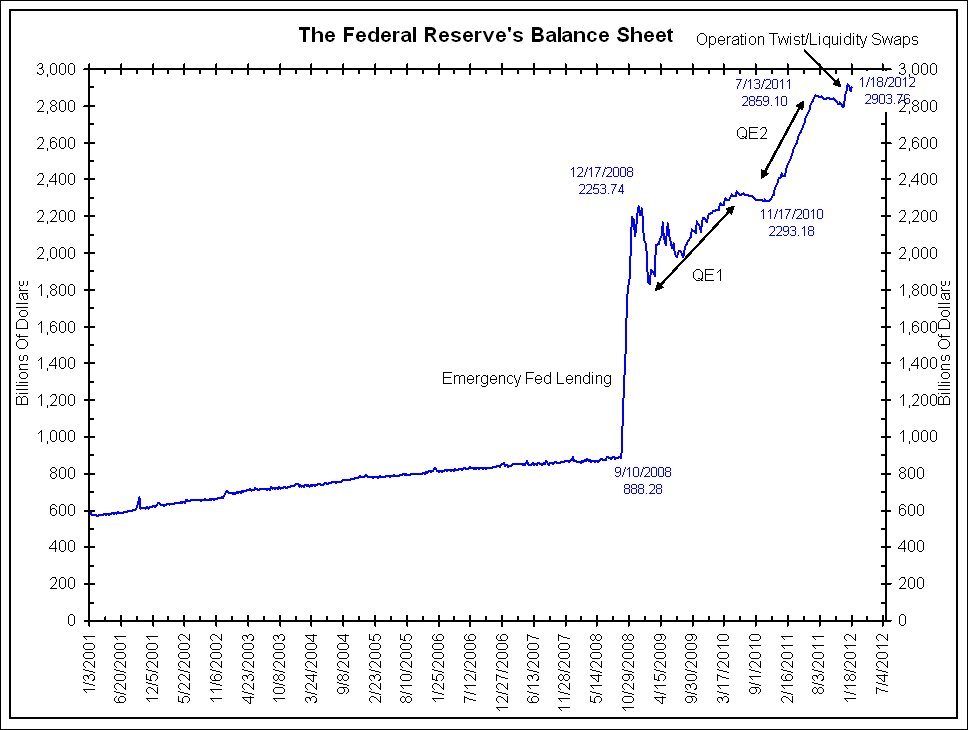
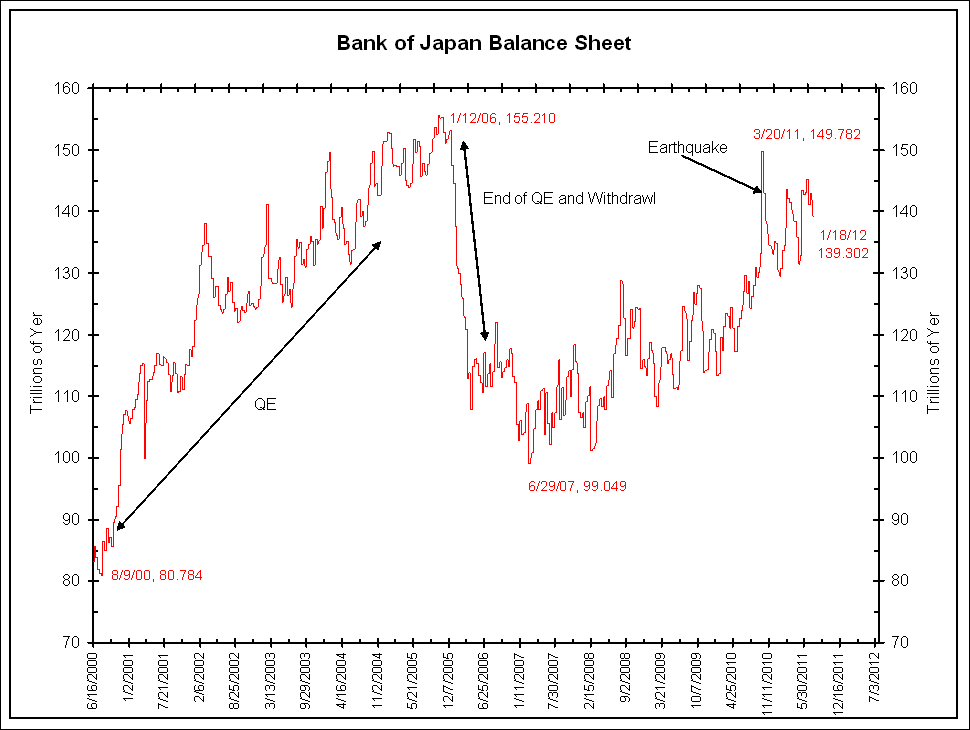
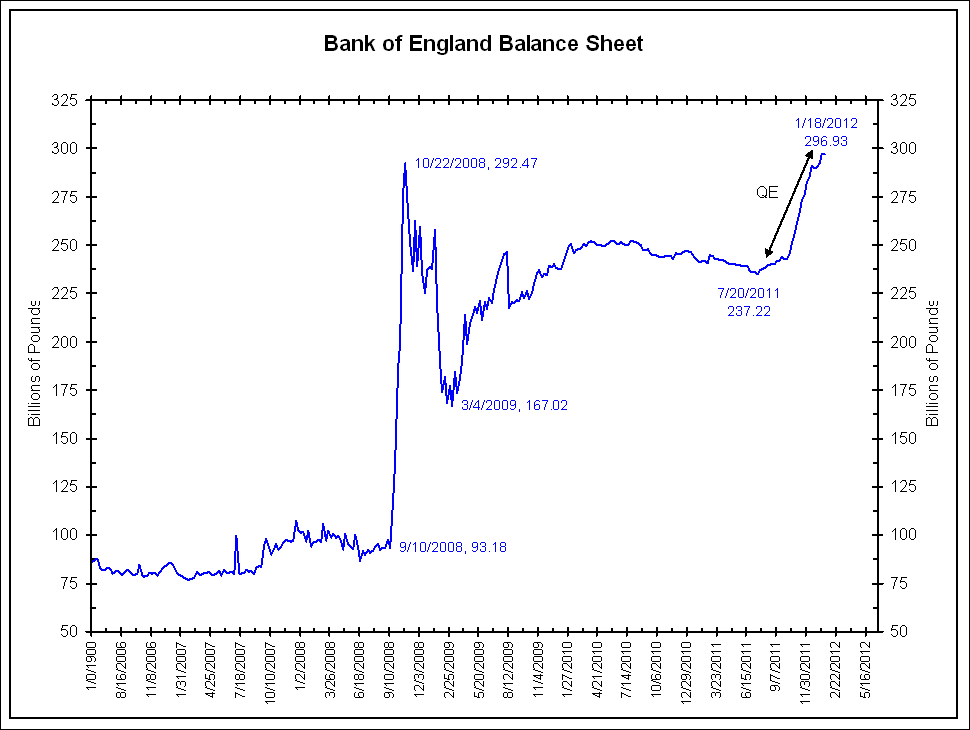
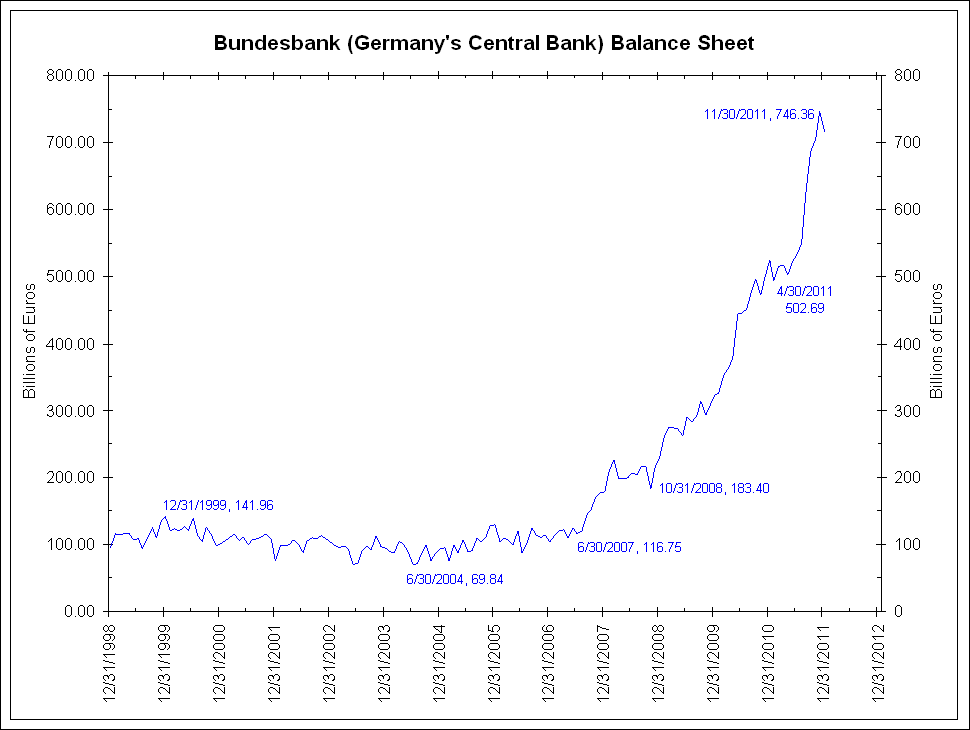
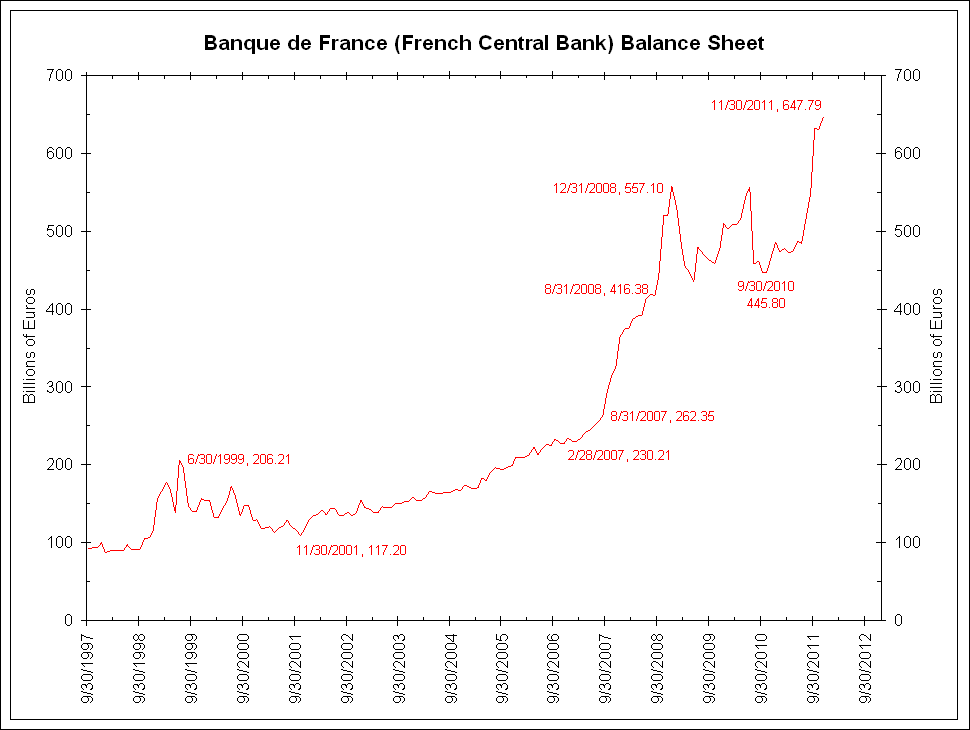
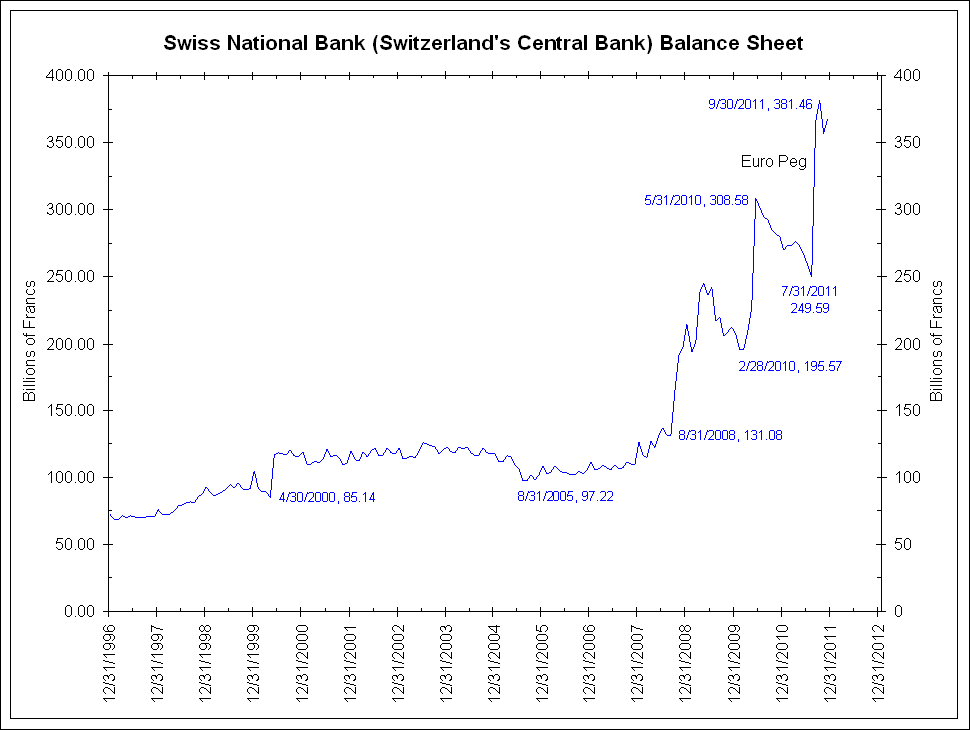
The first eight charts below show the balance sheets of the largest central banks in the world. They are the European Central Bank (ECB), the Federal Reserve (Fed), the Bank of Japan (BoJ), the Bank of England (BoE), the Bundesbank (Germany), the Banque de France, the People's Bank of China (PBoC) and the Swiss National Bank (SNB).  Noted on the charts are significant events or growth rates.

Shown is the size of each respective balance sheet in its local currency.  Note that all are exploding higher as every chart goes from the lower left to the upper right.  Most are still making new all-time highs. If the basic definition of quantitative easing (QE) is a significant increase in a central bank's balance sheet via increasing banking reserves, then all eight of these central banks are engaged in QE.

>

Click to enlarge:

˜˜˜

˜˜˜

˜˜˜

˜˜˜

˜˜˜

˜˜˜

>

Comparing Central Bank Balance Sheets

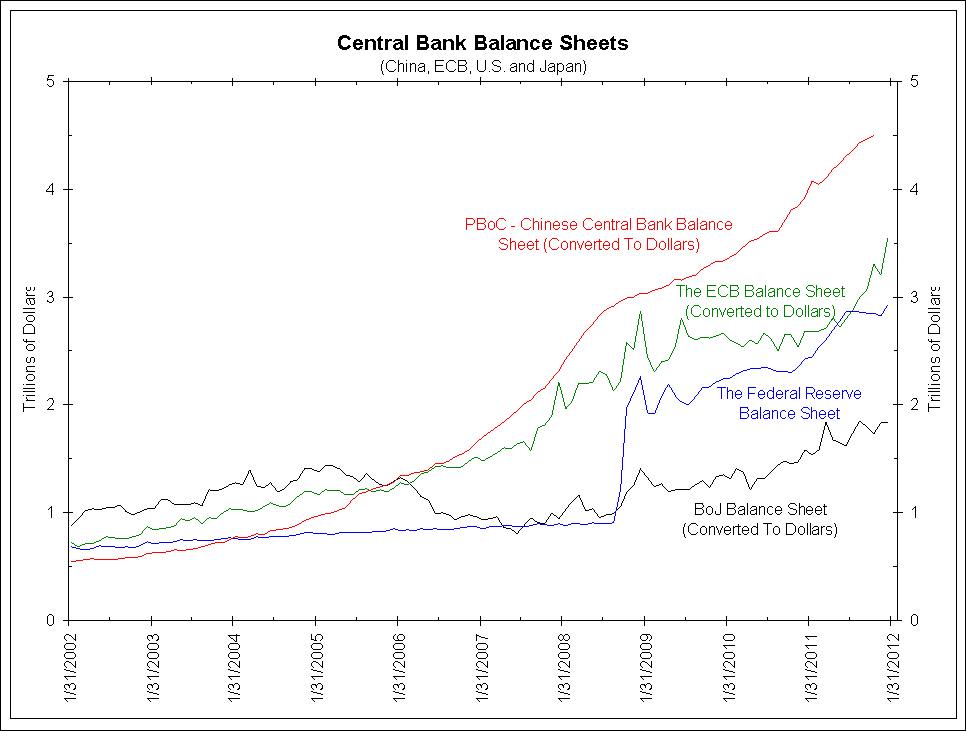
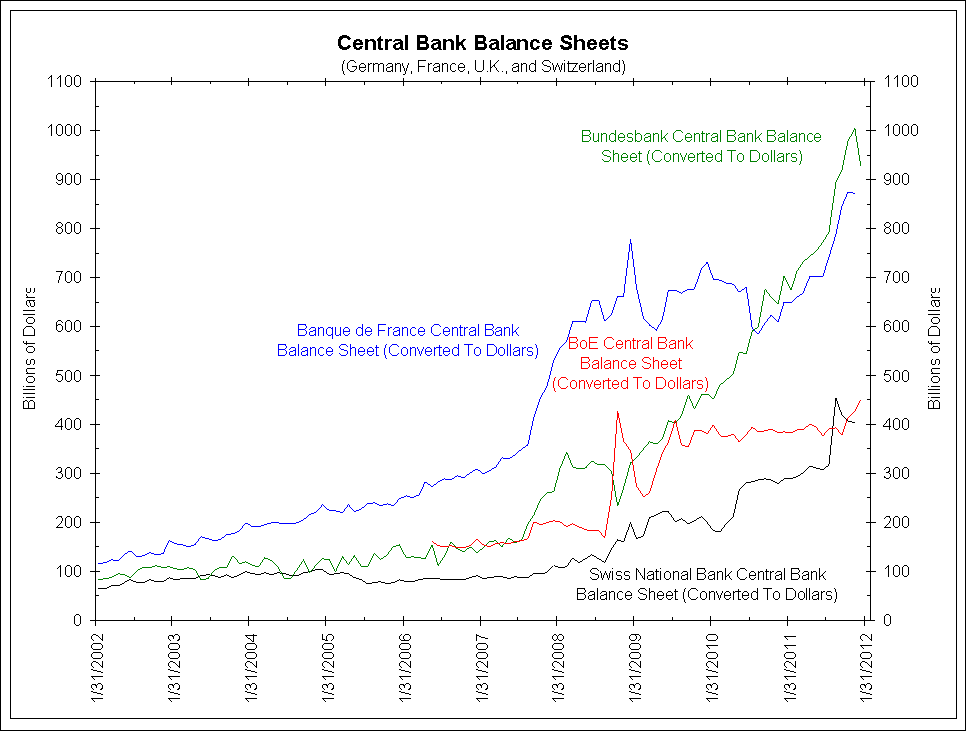
For comparison's sake, converted the eight balance sheets above into dollar terms.  The four largest, the PBoC, the Fed, the BoJ and the ECB are shown in the first chart below.  The second four, the Bundesbank, Banque de France, the BoE and SNB are shown in the second chart below.  I split them up because of their vastly different scales.

In the first chart, note that the balance sheets of the PBoC and the ECB are larger than the Federal Reserve when converted to dollars.  The BoJ used to be the largest balance sheet in dollar terms until 2006.

When shown in dollar terms below, the Bundesbank is the largest of the "second four" central banks.  Further, its growth rate over the last five years has been among the highest.  This is surprising since the Bundesbank is considered the "hard money" central bank.

Combining Central Bank Balance Sheets

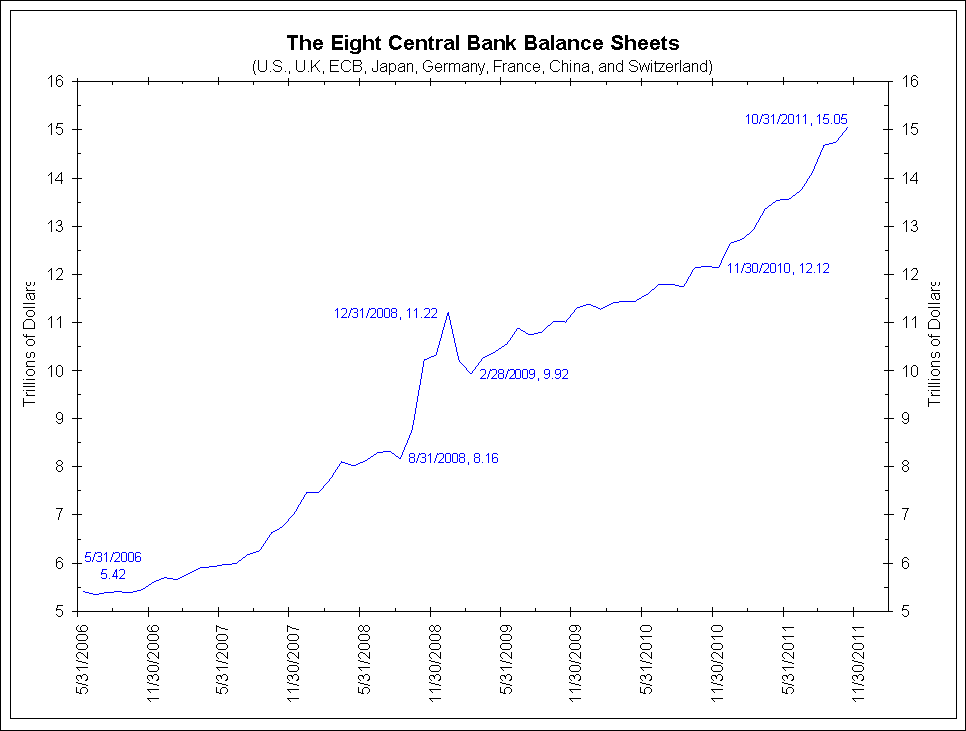
The next chart below adds up the eight largest central bank balance sheets in dollar terms.  It is only current through October as that is the latest number from the PBoC.

The combined size of these eight central banks' balance sheets has almost tripled in the last six years from $5.42 trillion to more than $15 trillion and is still on the rise!

Central Banks Equal To One-Third Of World Equity Values

As noted above, QE is an expanding of balance sheets via increasing bank reserves.  The purpose of QE, as explained by this Bank of England video,  is to increase bank reserves through purchases of fixed income securities in order to lower interest rates.  This makes fixed income securities relatively unattractive/overvalued and pushes investors out the risk curve.  This should increase buying for riskier assets such as stocks, pushing them higher in price.  Theoretically these higher prices should lead to a wealth effect and increased economic activity.

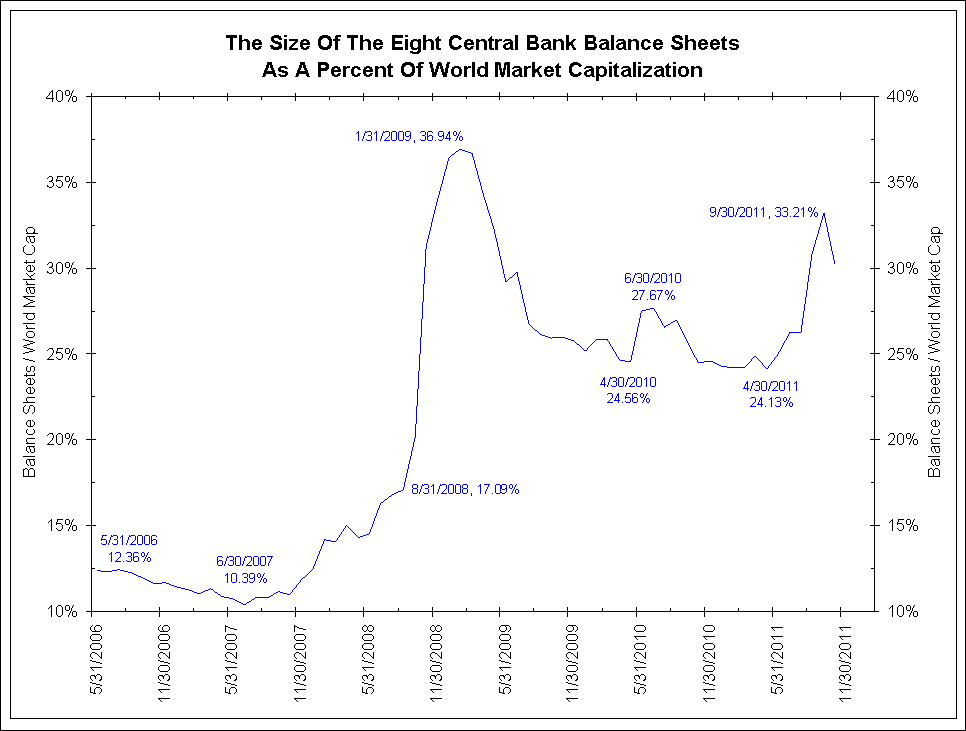
Given this definition and purpose, it is fair to compare the size of these balance sheets (now $15 trillion) to the capitalization of the world's stock markets (now $48 trillion).  This is shown in the chart below.

Prior to the 2008 financial crisis, the eight central bank balance sheets were less than 15% the size of world stock markets and falling.  In the immediate aftermath of Lehman Brothers' failure, these eight central bank balance sheets swelled to 37% the capitalization of the world stock market.  But keep in mind that the late 2008/early 2009 peak was due to collapsing stock market values combined with balance sheet expansion via "lender of last resort" loans.

Recently, the eight central bank balance sheets have spiked back to 33% of world stock market capitalization.  This has come about not by lender of last resort loans, but rather by QE expansion (buying bonds with "printed money") even faster than world stock markets are rising.

What Does It All Mean?

2011 was so difficult because all stocks seemingly moved together.  It was as if every S&P 500 company had the same chairman of the board that knew only one strategy, resulting in a high degree of correlation between seemingly unrelated companies.

Massive central bank involvement in the markets risks returning us to a de facto centrally planned economy. Those S&P 500 companies all have the same chairman; it is Ben Bernanke because his policies are affecting everybody. That is what makes money management so difficult. Correlations will ebb and flow; they always do. But what makes them go away? This will only happen when governments and central banks go away.

But if they go away, then does that not mean things get ugly? Maybe they do get ugly, but it also means that we sort out the excesses in the market. We reward the people that do the right thing and we punish the people that do the wrong thing. And we have an adjustment process that may be ugly, but then we have a period of long expansion.

Central banks are ruling markets to a degree this generation has not seen.  Collectively they are printing money to a degree never seen in human history.

So how does this process get reversed?  How do central banks pull back trillions of dollars of money printing without throwing markets into a tailspin?  Frankly, no one knows, least of all central banks as they continue to make new money printing records.

Until a worldwide exit strategy can be articulated and understood, risk markets will rise and fall based on the perceptions and realities of central bank balance sheets. As long as this is perceived to be a good thing, like perpetually rising home prices were perceived to be a good thing, risk markets will rise.

When/If these central banks go too far, as was eventually the case with home prices, expanding balance sheets will no longer be looked upon in a positive light.  Instead they will be viewed in the same light as CDOs backed by sub-prime mortgages were when home prices were falling.  The heads of these central banks will no longer be put on a pedestal but looked upon as eight Alan Greenspans that caused a financial crisis.

The tipping point between balance sheet expansion being bullish for risk assets versus bearish is impossible to know.  Given the growth rate of central bank balance sheets around the world over the past few years, we might not have to wait too long to find out.  Enjoy it while it is still bullish.